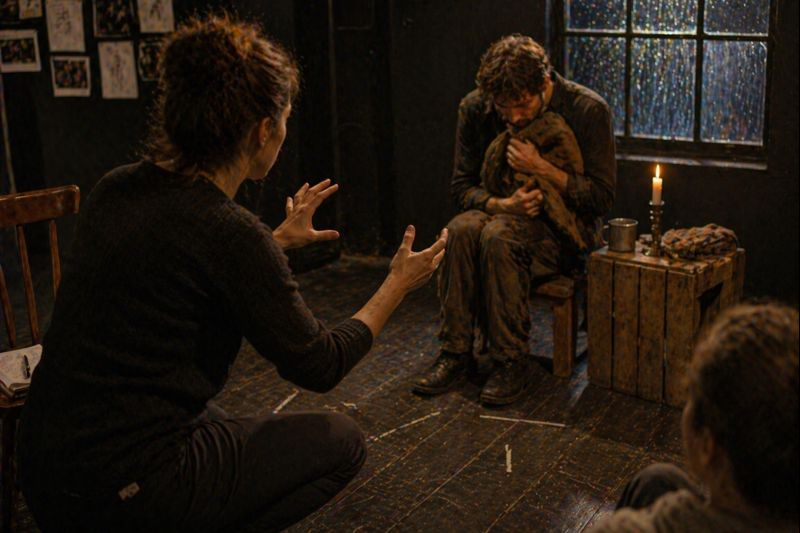
A short story often succeeds when a single scene feels like the entire world.
Limiting scope can focus emotion, theme, and character more acutely than sprawling plots.
Writers who lean on a scene’s detail and stakes let readers infer what lies beyond the margins.
This piece outlines practical strategies to let one scene carry narrative weight and resonance.
Choose the Scene That Holds the Most Change
Start by identifying the moment when something shifts—the choice, the revelation, the loss. That instant should alter a character’s inner or outer trajectory, and it must be visible within the scene. Discard setups that merely lead to later events; instead place the pivot here so the scene contains cause and consequence. A tightly chosen turning point concentrates meaning and gives the story a central spine.
If the scene doesn’t change a life, it should at least change what the character believes. Test each beat by asking what would be lost without it.
Use Sensory Anchors to Expand a Small Moment
Sensory details create a believable micro-world and imply the wider context. Choose two or three concrete sensory anchors—a scent, a sound, a tactile object—and return to them to build rhythm. These anchors make the scene immersive without requiring exposition, letting readers reconstruct background from fragments. Each repeated detail accrues emotional meaning.
Avoid listing sensations; instead, link them to character memory or desire. That linkage turns a detail into a thematic echo.
Let Conflict and Choice Scale the Scene
Conflict needn’t be physical or loud; internal contradictions or social pressure can supply enough force. Frame the stakes so the scene’s outcome matters to the character’s sense of identity, relationships, or future. Keep the cast small; focus attention on how choices reverberate rather than on plot mechanics. Pacing is crucial—compress moments of decision to heighten consequence.
When choices feel inevitable yet fraught, the scene reads as consequential. Readers will sense the broader implications without explicit exposition.
Trust Implication and Let the Ending Hum
Endings in short scenes often succeed by implication rather than resolution. A line of dialogue, a residual image, or a repeated sensory note can hang in the reader’s mind and suggest consequences beyond the page. Resist the urge to explain every fallout; let readers fill the negative space with inference. A subtle, earned ending makes the scene feel like a seed of a larger narrative.
Revise toward implication: remove lines that spell things out, then test whether the image still holds. If it does, the scene likely carries its weight.
Conclusion
Let one scene shoulder the story’s meaning.
Trust detail, choice, and implication.
Small, precise scenes can echo far beyond their page.