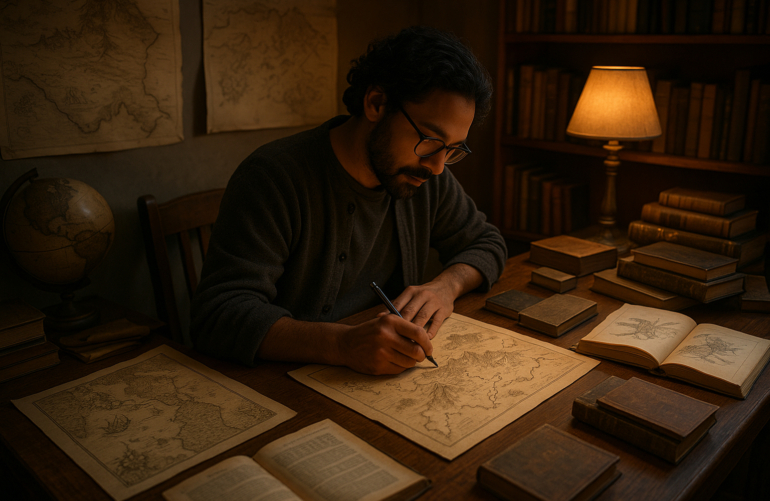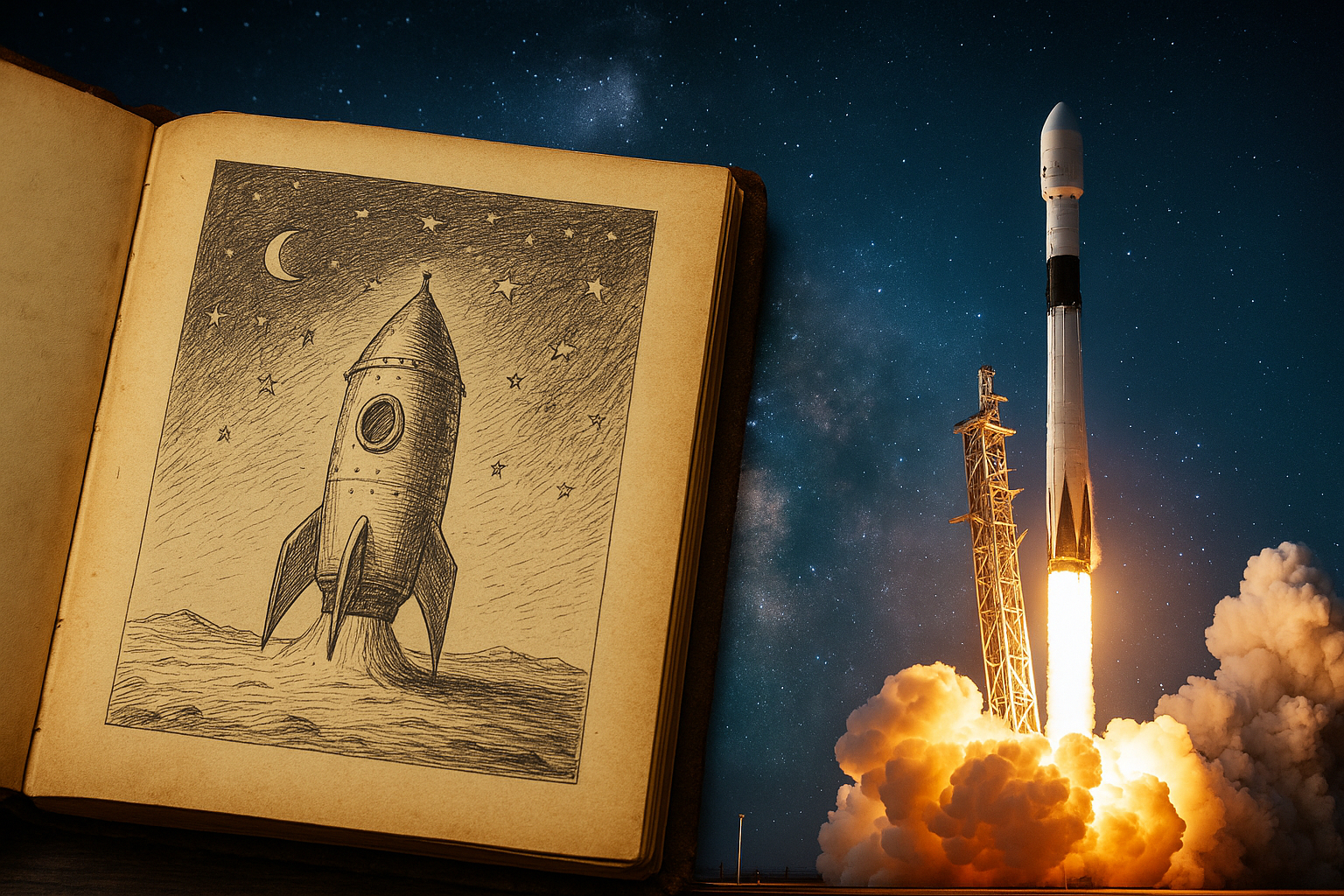
Long before humanity ever built a rocket, writers had already imagined leaving Earth. From early tales of moon voyages to modern visions of interplanetary colonization, space travel has captured the human imagination for centuries. What began as fantasy in the pages of novels has evolved into reality — and literature has been there every step of the way. The journey from Jules Verne’s fictional moon launch to Elon Musk’s real-life Mars ambitions shows how storytelling doesn’t just predict the future — it inspires it.
The Birth of Space Imagination
In the 19th century, when space exploration was still a dream, Jules Verne’s From the Earth to the Moon (1865) introduced readers to the idea of humans traveling beyond the atmosphere. His detailed descriptions of spacecraft design, launch mechanics, and even weightlessness were astonishingly ahead of their time. Verne’s scientific curiosity and optimism turned fantasy into foresight, inspiring generations to believe that exploration beyond Earth was not only possible but inevitable.
Early 20th Century: From Wonder to Warning
As technology advanced, writers began exploring not just the wonder of space, but its consequences. Authors like H.G. Wells (The War of the Worlds) used extraterrestrial themes to reflect human ambition, fear, and morality. Later, during the early space age, Ray Bradbury’s The Martian Chronicles portrayed space as both a dream and a warning — a place where humanity’s flaws might follow it beyond Earth. These works marked a turning point: space was no longer just an adventure, but a mirror of human nature.
The Golden Age of Science Fiction
The mid-20th century — often called the “Golden Age” of science fiction — saw space travel become central to popular culture. Writers like Arthur C. Clarke (2001: A Space Odyssey), Isaac Asimov, and Robert Heinlein crafted stories grounded in scientific realism, exploring the ethics, technology, and psychology of living in space. Their visions coincided with real-world milestones like Sputnik, Apollo 11, and the moon landing. Fiction and science began feeding off each other — one imagining the possibilities, the other making them real.
Space as a Metaphor for Humanity
Beyond science, literature has long used space as a symbol — of hope, loneliness, exploration, and belonging. Modern writers like Carl Sagan and Andy Weir (The Martian) have blended rigorous science with emotional storytelling, reminding readers that the quest for the stars is also a search for meaning. Space travel, in this sense, isn’t just about escaping Earth; it’s about understanding ourselves and our place in the universe.
From Page to Reality: The Age of Elon Musk
Today, figures like Elon Musk, Jeff Bezos, and Richard Branson have transformed the dream of space travel into an engineering race. SpaceX rockets and Mars colonization plans echo the ideas once confined to novels. In many ways, Musk’s ambition feels like a sequel to Verne’s vision — turning fiction into future. Literature laid the groundwork by inspiring belief, and technology is now catching up to imagination.
Conclusion
The story of space travel in literature is a story of human imagination pushing past limits. From Verne’s paper-bound rockets to Musk’s reusable ones, writers and dreamers have shaped our collective vision of what lies beyond the stars. Every generation of authors has redefined space — from a faraway fantasy to a tangible next step in human evolution. As science continues to explore new frontiers, literature remains the launchpad — reminding us that before we travel through space, we must first travel through imagination.