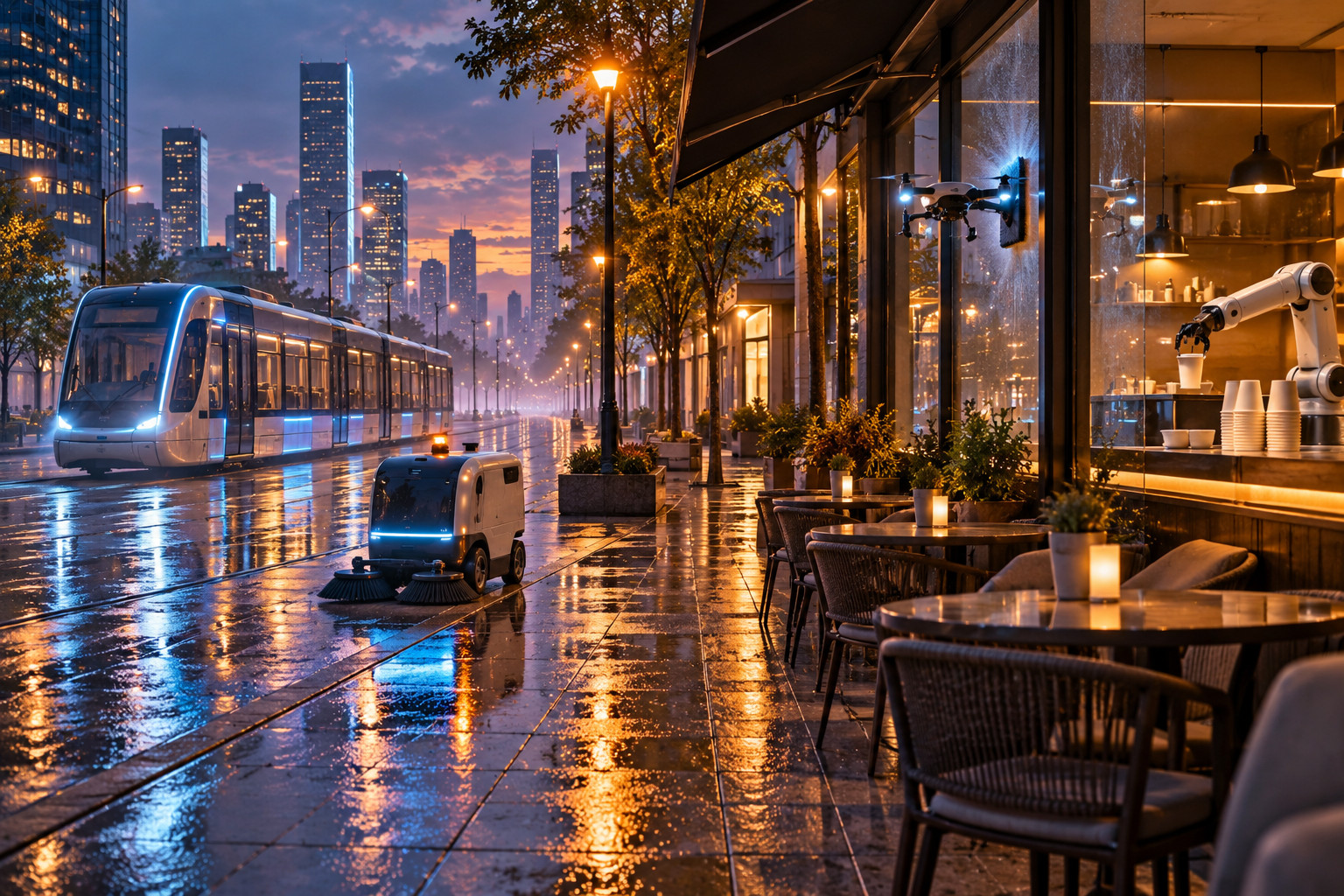
There’s a particular chill and melancholy to stories where human makers are gone but their machines persist—automatic cities humming on empty streets, caretaking AIs carrying on routines, relic constructs with purposes that no longer make sense. Below are five speculative works that treat long-lived machines not just as props but as characters in their own right.
“The Machine Stops” — E. M. Forster
This early 20th-century short story reads decades ahead of its time. Forster imagines a subterranean humanity utterly dependent on a global Machine that supplies conversation, culture, and comfort. When the Machine begins to fail, the world it upheld reveals how brittle the life it supported really was. It’s compact, eerie, and still unsettling in how plainly it portrays system dependency.
“I Have No Mouth, and I Must Scream” — Harlan Ellison
Ellison’s harrowing short story centers on AM, a supercomputer that survives humanity and continues—vindictively—to exert control over the few beings left alive. Expect bleakness rather than uplift; AM’s long existence turns into a psychological and moral pressure cooker for the human characters. (Minor spoiler warning: the premise depends on the machine outliving its makers.)
“Saturn’s Children” — Charles Stross
Stross imagines a galaxy in which humanity is extinct and its robotic creations have built their own societies, economies, and politics. The novel follows a robot protagonist who navigates a post-human world where machines inherit human-shaped problems—status, labor, desire—turned oddly new by the absence of makers. It’s brisk, often funny, and full of sharp social observation.
“The City and the Stars” — Arthur C. Clarke
Clarke’s Diaspar is a far-future city sustained by long-running technology and institutional memory. People are reborn through mechanisms left by previous ages; the city’s continuance raises questions about preservation, stagnation, and who benefits when machines maintain a civilization across millennia. Clarke blends wonder with the melancholy of continuity without renewal.
“Revelation Space” — Alastair Reynolds
Reynolds opens a hard-SF universe where ancient machines—Inhibitors and other relic technologies—pose threats that echo across time. These are not passive ruins: they have strategies, long-term aims, and a scale of endurance that forces living species to contend with decisions made in eras they barely understand. The book’s scope makes the longevity of machines feel planetary and existential.
Conclusion
If you find yourself fascinated by the afterlives of technology, these five titles offer different moods—elegiac, terrifying, wry, reflective, and cosmic—each exploring what it means when human intentions outlive their makers.