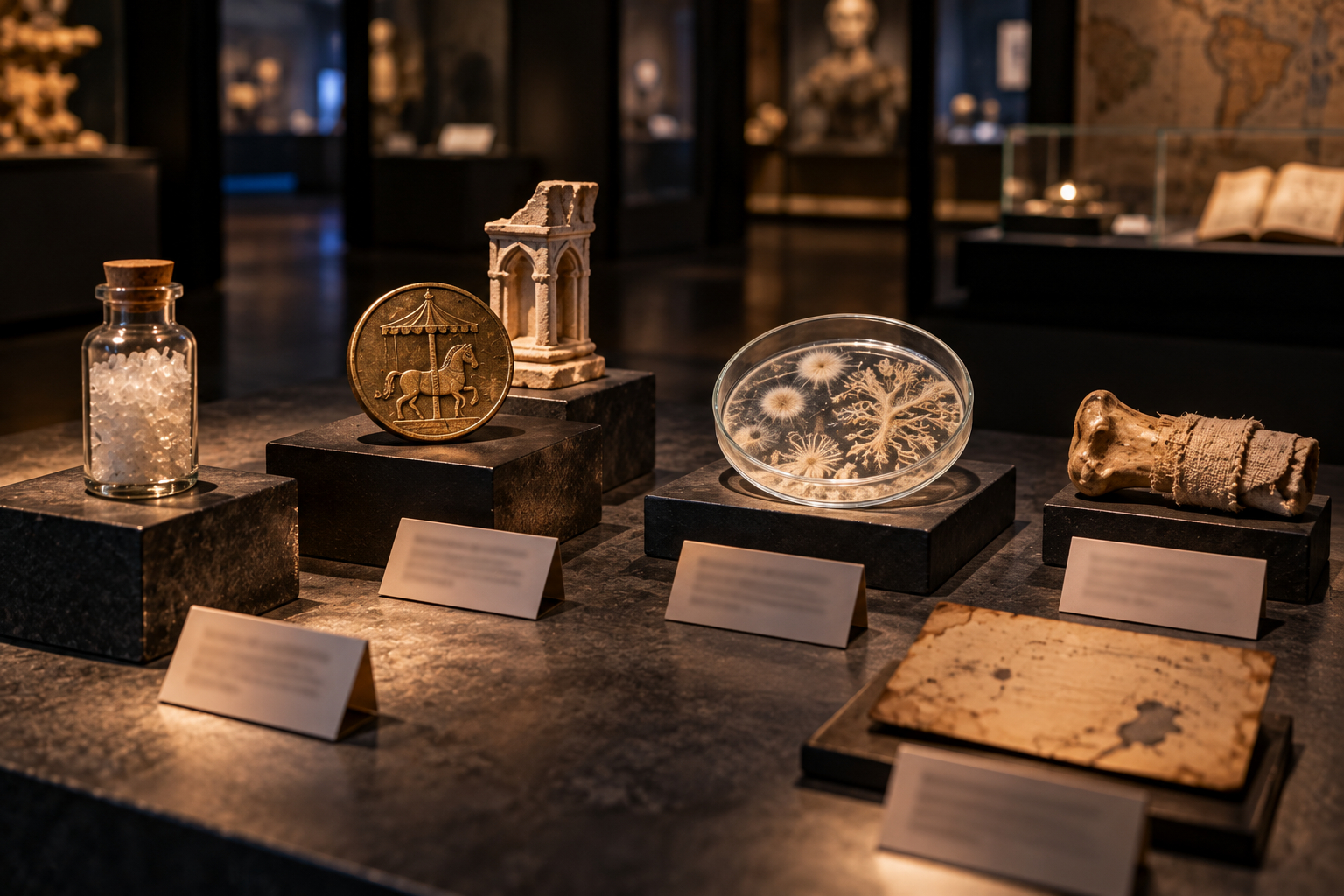
Some nonfiction reads like a sweeping thesis; others find the wide, surprising world inside a single thing — a mineral, a fair, a cell, a body, a book. The five titles below do that work: they take close objects or moments and use them as keys for larger truths about trade, science, mortality, language, and the human cost of progress. Each feels like a small door into a room you didn’t expect to find.
Salt: A World History — Mark Kurlansky
Kurlansky turns something ordinary and essential into an unlikely history lesson. Salt becomes a lens for trade routes, wars, culinary habits, and the ways communities organized life around a preservative people take for granted. Read this if you enjoy seeing ordinary materials reveal economic and cultural patterns across centuries.
The Devil in the White City — Erik Larson
Larson threads together two very different strands around the 1893 Chicago World’s Fair: the architectural ambition that reshaped a city and a darker personal story unfolding in its shadow. The book’s tension comes from that contrast — public spectacle and private menace — and how both helped define a moment in American modernity.
The Immortal Life of Henrietta Lacks — Rebecca Skloot
Skloot’s book follows the story of the HeLa cells and the family behind them. It’s part scientific history, part portrait of a family confronting how medical research used the tissue of a Black woman without her knowledge. This is a humane account that asks readers to consider ethics, race, and the unseen people whose bodies made modern medicine possible.
Stiff: The Curious Lives of Human Cadavers — Mary Roach
Mary Roach approaches a taboo subject with curiosity and wit. Stiff looks at the many uses cadavers have served — in science, crash tests, medical training — and the cultural attitudes that shape how societies treat the dead. The tone can be frank and occasionally comic, but the underlying respect for the subject keeps the book thoughtful rather than sensational.
The Professor and the Madman — Simon Winchester
Winchester tells the odd, engrossing story behind the making of the Oxford English Dictionary. At its center is an unlikely collaboration between the dictionary’s editor and one of his most prolific contributors, a man confined in an asylum. The book reveals how obsession, scholarship, and the slow accumulation of small contributions built a scholarly monument.
Conclusion
Each of these books begins with a narrow focus and ends with a wider view — about power, ethics, industry, or human curiosity. Pick one that matches your curiosity: mineral history, urban spectacle, medical ethics, bodily science, or the labor behind our words. Any of them makes for a small reading commitment that changes the way you look at something ordinary.