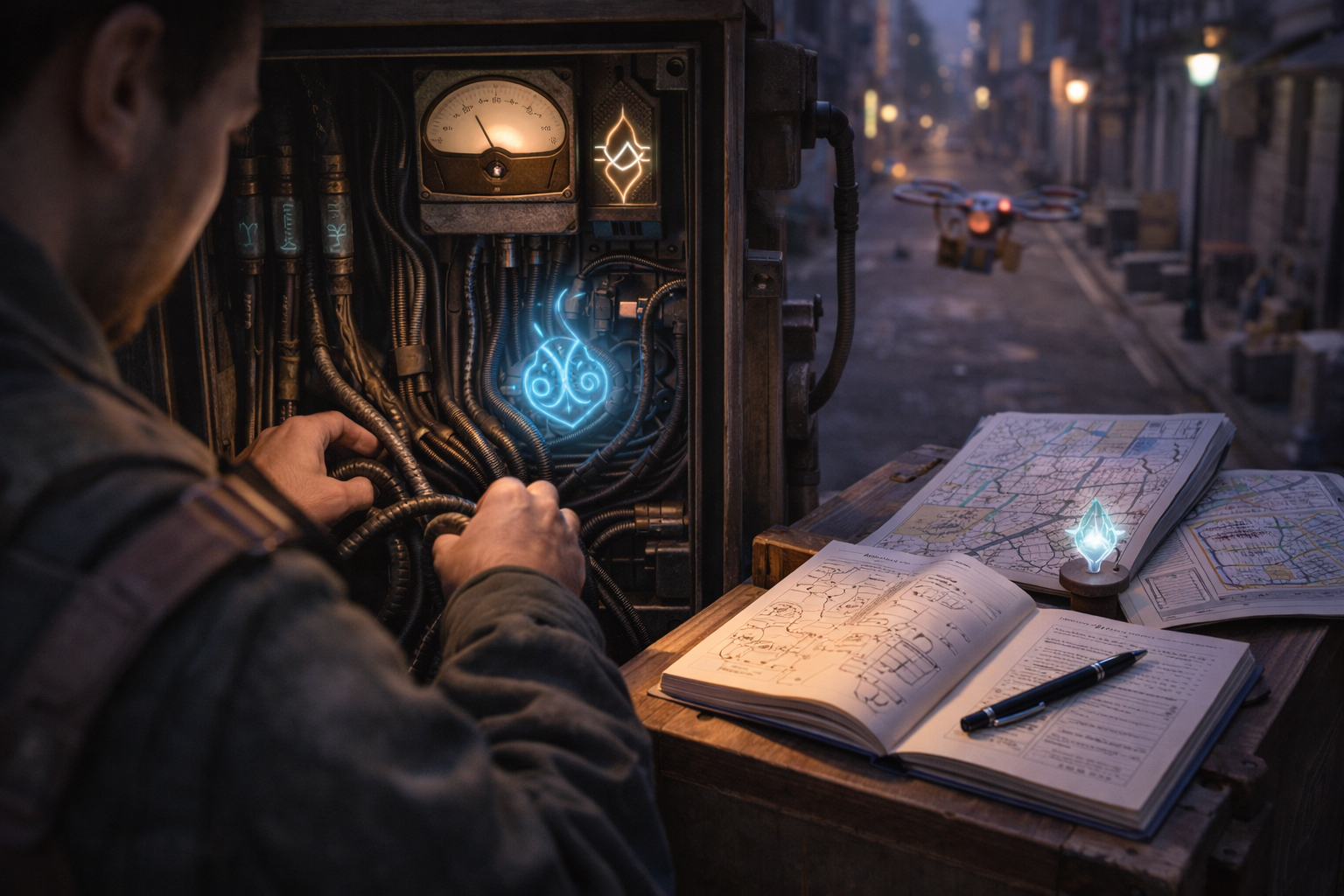
Fictional worlds that pair spell craft with automation require clear rules so infrastructure behaves plausibly.
When magic powers streetlights, augments machines, or substitutes for fuel, the city’s systems change in predictable ways.
Authors who map those interactions save readers from narrative dissonance and open plot possibilities.
This guide sketches practical ways to adapt power, maintenance, and governance to a mixed-tech, mixed-magic infrastructure.
Power, Flow, and Resource Accounting
Start by deciding what energy looks like in your setting and how it is measured. If spells are a transient resource and batteries are persistent, systems will prioritize different loads; networks must handle fluctuating input and latency differently than steady-state power. Establish conversion costs and loss rates so that using magic has trade-offs comparable to fuel or electricity. With consistent accounting, you can create conflicts over scarcity, theft, or prioritization that feel inevitable rather than contrived.
– Define sources (ambient mana wells, ritual nodes, engineered reactors) and typical output profiles.
– Consider meters and diagnostics: who reads arcane flow and how errors are detected?
Treat magic as another form of energy within infrastructure, with its own economics and failure modes. That framing helps determine who controls access and why certain technologies persist alongside enchantments.
Maintenance, Labor, and Skill Transmission
Hybrid systems demand hybrid expertise: technicians who understand circuitry and sorcery, and guilds that codify unsafe practices. Maintenance routines change when self-healing wards can replace routine repairs or when enchanted components degrade under different conditions than mechanical ones. Apprenticeships, certifications, and black-market charms become natural institutions, and the existence of both manual and magical fixes shapes employment and social status.
– Sketch certification paths: formal schools, private tutors, illegal vendors.
– Decide how knowledge spreads: codified manuals, secret sigils, or experiential learning.
These social mechanics create believable hierarchies and plot hooks, from strikes by repair unions to clandestine sales of forbidden runes.
Regulation, Redundancy, and Urban Design
Cities adapt physically to hybrid infrastructure by layering redundancy and zoning. Critical systems may require dual feeds—one mundane, one arcane—so outages are rare but consequential. Planners might isolate high-magic districts to limit contagion of wild enchantments, while transport hubs prioritize sensors that read both electromagnetic and aetheric signatures. Legal frameworks, insurance models, and emergency responses all change when both spells and machines can fail.
– Design redundancy: backup wards, fail-safe dampeners, or manual override protocols.
– Map urban zones by resource density and risk tolerance.
Redundancy and regulation generate dramatic stakes without resorting to deus ex machina; they also let you justify why some innovations spread slowly.
Conclusion
Treat magic as an infrastructural variable with rules, limits, and economic consequences to keep systems believable.
Layer maintenance, governance, and urban planning around those rules to create natural tensions and plot opportunities.
Consistent constraints let your hybrid world feel lived-in and logically coherent.