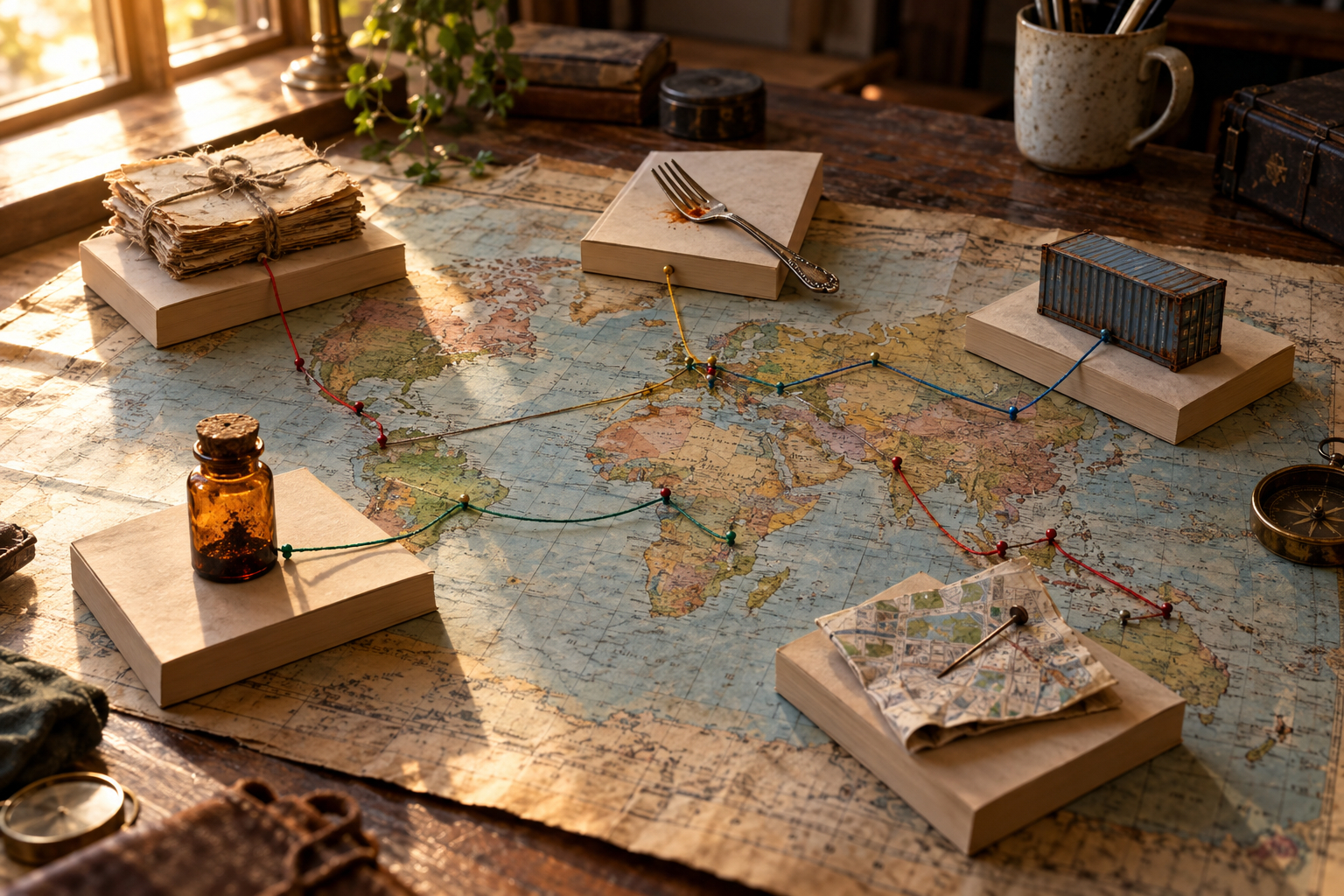
There’s a particular pleasure in holding something ordinary and discovering the way its history spills outward—cities reformed, industries remade, lives rearranged. These five nonfiction books begin with small, specific things—a word, a container, a fork—and follow the surprising lines those things draw through politics, science, and human stubbornness.
The Professor and the Madman — Simon Winchester
Winchester turns the Oxford English Dictionary into a canvas for a strange, human drama. At the center: an army surgeon who sent thousands of entries from an asylum and the lexicographer who accepted them. The book reads like a detective story crossed with intellectual history, and it highlights how a single scholarly project quietly shaped modern English.
The Ghost Map — Steven Johnson
Johnson uses a deadly 1854 cholera outbreak in London to explore how cities and science changed together. The narrative tracks a physician and an amateur mapmaker whose observations forced a rethinking of how disease travels through water and urban life. It’s atmospheric and surprising, the kind of history that makes a city feel like a character.
The Box: How the Shipping Container Made the World Smaller and the World Economy Bigger — Marc Levinson
Levinson shows how a uniform metal box remade global trade, transformed ports, and shifted labor patterns. If you’ve ever wondered why goods cost what they do or why some cities boomed while others faded, this book links those questions to the simple geometry of standardized freight. It’s a reminder that logistics can be history’s quiet engine.
Consider the Fork: A History of How We Cook and Eat — Bee Wilson
Food habits seem intimate, but Wilson reveals how tools and techniques—utensils, stoves, preservation methods—rearrange taste, work, and social norms. Short chapters move from kitchens to chemistry to manners, making every meal feel like an artifact worth studying. It’s a lively, approachable history for readers who like context with their recipes.
The Poisoner’s Handbook: Murder and the Birth of Forensic Medicine in Jazz Age New York — Deborah Blum
Blum follows two pioneering scientists as they develop forensic chemistry under the pressure of real cases. Through poisons and courtrooms, you see how modern criminal investigation took form and how a handful of lab techniques reshaped public policy and perceptions of risk. The writing is crisp and occasionally chilling.
Conclusion
If you enjoy histories that start small and widen into systems—language, cities, trade, kitchens, justice—these books offer accessible, vividly drawn gateways. Pick one that connects to a curiosity you already have, and let that ordinary thing lead you into an unexpectedly large story.