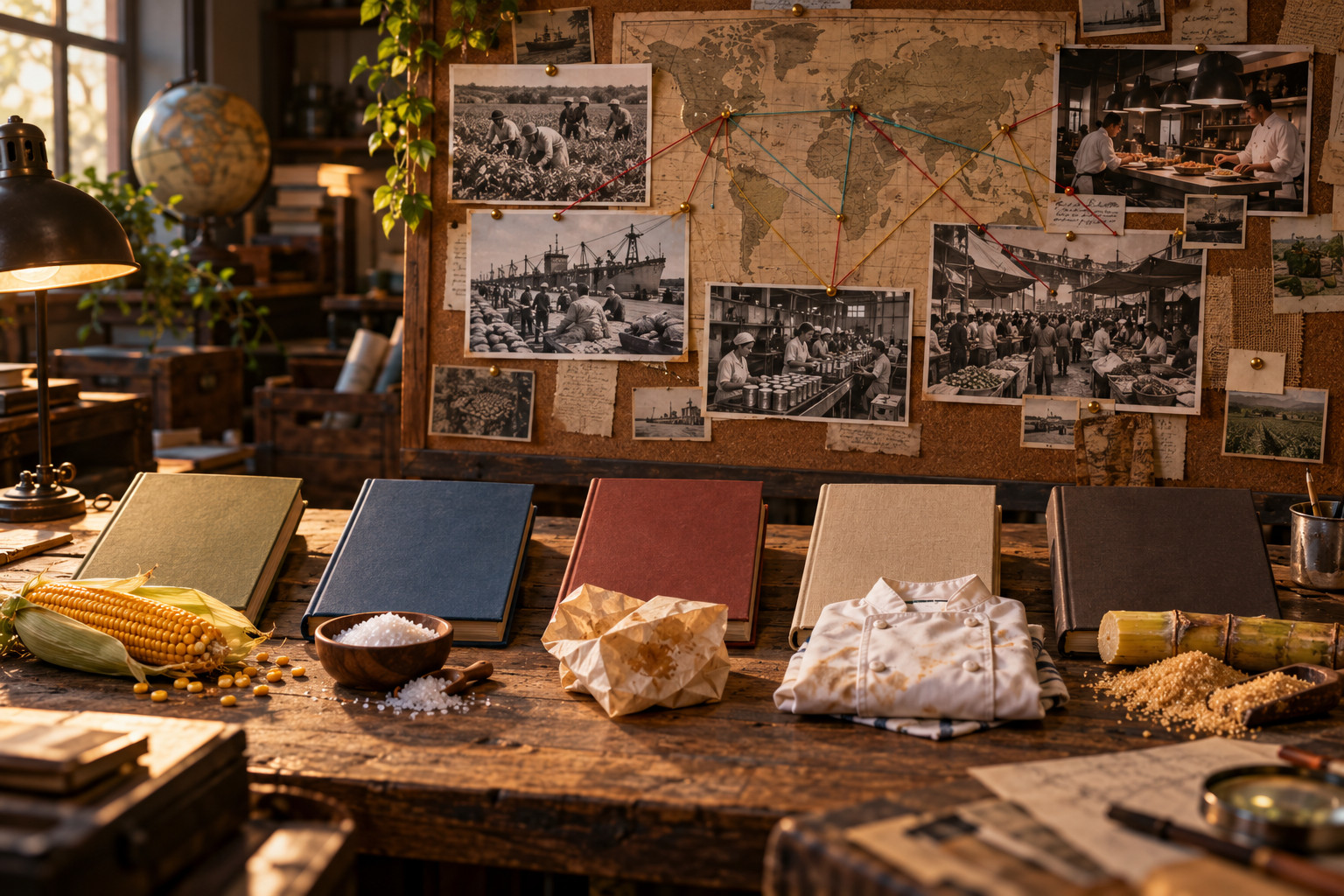
Food is never just food. It carries labor and trade routes, memory and policy, empire and innovation. The five books below turn meals into stories you can follow across continents, factory floors, markets, and kitchens. Pick one if you want reporting that clarifies supply chains, memoir that uncovers a restaurant’s interior life, or history that reframes a familiar taste.
The Omnivore’s Dilemma — Michael Pollan
Pollan follows four meals from field to fork, asking what we’re actually eating and why. He mixes reporting with clear, sometimes wry reflection, tracing industrial corn systems alongside small-scale farms and foragers. Readers who like a curious, investigative voice will appreciate how Pollan connects daily choices to economics and ecology.
Salt: A World History — Mark Kurlansky
Kurlansky takes one humble mineral and uses it as a passport. Salt’s role in trade, cities, and warfare emerges in short, readable chapters that move from ancient mines to modern markets. The book reads like a series of vivid vignettes—useful when you want history condensed into surprising cultural details rather than dry chronology.
Fast Food Nation — Eric Schlosser
Schlosser’s reporting on the American fast-food industry lays out how a single business model reshaped agriculture, labor, and public health. He pairs investigative chapters with on-the-ground profiles, showing the system’s human and environmental costs without turning every page into a polemic. Expect reporting that makes you look differently at convenience.
Kitchen Confidential — Anthony Bourdain
Bourdain’s memoir reads like a midnight conversation in a bustling kitchen: raw, funny, and exact about the restaurant trade. It’s less about recipes and more about the rhythms, hierarchies, and personalities behind the pass. Readers drawn to voice and scene will find it immediate and entertaining—full of detail, not culinary instruction.
Sweetness and Power — Sidney W. Mintz
Mintz examines how sugar shaped consumer culture, labor systems, and empire from the Caribbean plantations to European tables. It’s an anthropologist’s look at how taste and economic structures intertwine—rewarding if you enjoy social history that tracks an everyday commodity through global change.
Conclusion
These five books approach food from different angles—reporting, history, memoir—but they all expand the meal into a story about the world. Pick one to start and let a single ingredient or kitchen reveal a much larger map beneath your next bite.